The Office Perimeter: Reception, Executive Suites, and Server Rooms
Hardening the executive office is different from hardening a residence. Here's how to think about reception, executive suites, and server room security.
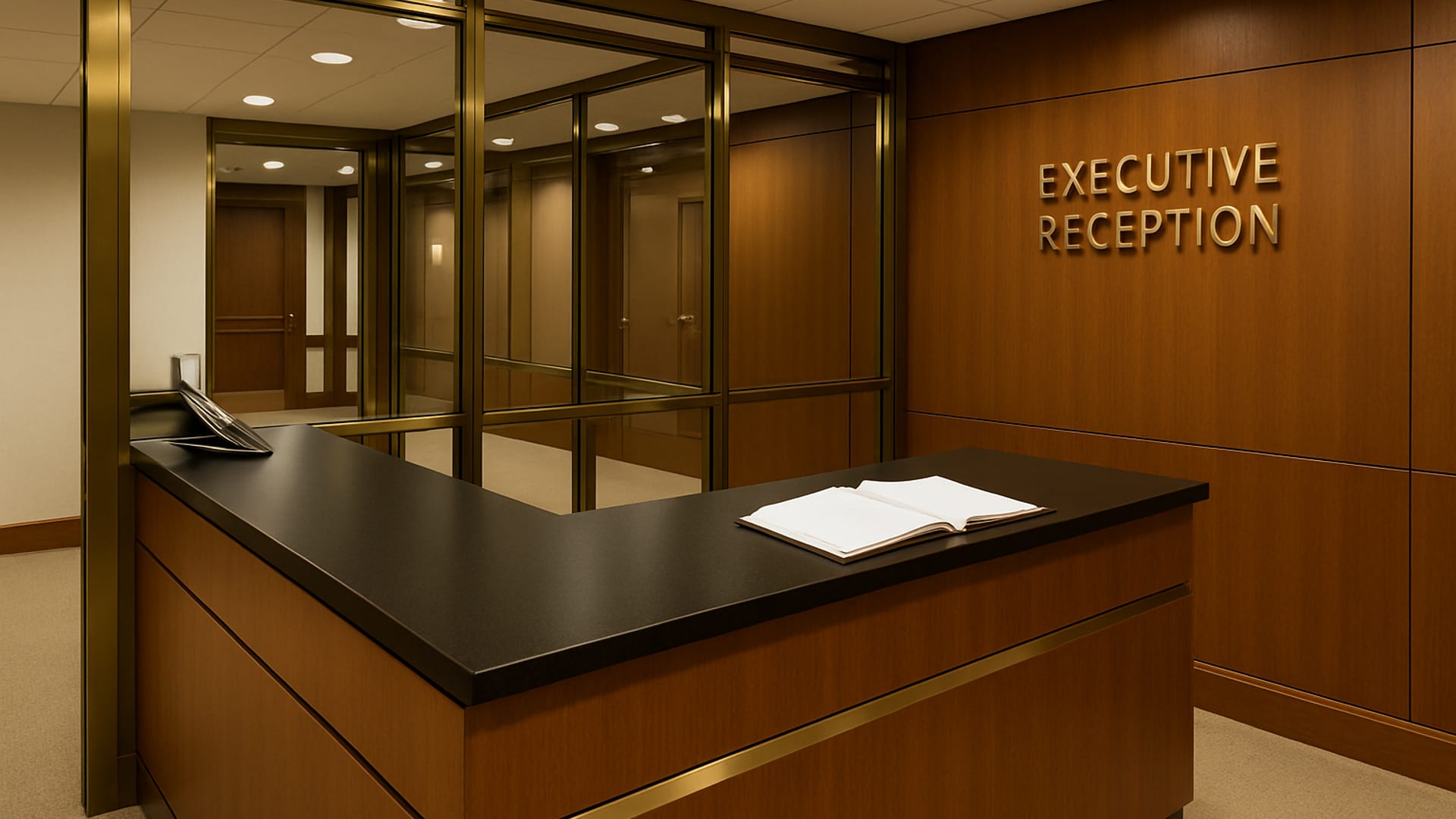
Offices are busy. That is the design. And that is the exposure.
An executive office is designed to let people in. Clients. Employees. Delivery drivers. Vendors. Job applicants. Consultants. Catering. Cleaners. Inspectors. At any given moment during business hours, a well-run office has a rolling population of people who should be there and a small but nonzero number of people who should not.
Hardening an office is not about making it unwelcoming. It is about building the layered posture that lets the office do its work while managing the access that comes with that work. The difference between a well-hardened office and an undefended one is usually not visible to the people passing through. It is built into the reception routine, the access control, the interior layout, and the discipline of the people who work there.
The three zones of office hardening.
Zone 1: Reception and public access
The front of the office. The place where most visitors form their first impression and where most controllable access happens.
What hardens well:
- A staffed reception during business hours, with trained personnel
- Visitor check-in process (log, badge, escort if appropriate)
- Clear signage directing visitors to the reception point
- Physical separation between reception and interior work areas
- Panic button or duress signal for reception staff
- Camera coverage of the reception area and approach
The most common reception weakness is that the protocol has drifted over years of casual use. Regular visitors get waved through. Packages get accepted at the door. Delivery drivers wander past reception to find someone. Each small drift erodes the layer.
Zone 2: Work areas and general access
Past the reception, the broader work area. Cubicles, meeting rooms, conference spaces, breakrooms.
What matters:
- Controlled access from reception into the interior (badge, escort, or similar)
- Clearly identified employees (badges or known faces)
- Meeting room placement that does not require visitors to traverse the full office
- Visible boundaries between visitor-appropriate areas and staff-only areas
- Doors that can be secured if needed, even if not normally locked
Zone 3: Sensitive spaces
Executive suites, server rooms, file storage, cash-handling areas, and any other spaces where access should be tightly controlled.
What matters:
- Dedicated access control (key, fob, code, biometric) distinct from general office access
- Logged entry: who came in, when
- Camera coverage on entries to sensitive spaces
- Clear written policy on who is authorized for each sensitive space
- Periodic review of authorized personnel lists
Sensitive spaces are where access control discipline pays back most directly. An office with casual general access but tight sensitive-space access is considerably more secure than one where every interior space has the same access level.
The reception discipline.
Reception is the most leveraged point in office security. A well-run reception prevents most problems. A poorly-run reception is where most problems originate.
The elements of strong reception
- Trained personnel. Reception staff should be trained specifically on security responsibilities, not just hospitality functions.
- Documented process. Every visitor gets logged, badged, and escorted as appropriate.
- Visible signage. Visitors know to come to reception; employees know to redirect anyone who bypasses it.
- Authority to challenge. Reception staff must feel empowered to ask questions of anyone entering, regardless of apparent status.
- Backup for absences. Reception cannot be left unstaffed during business hours. If the primary reception staff is on break, a designated backup covers.
- Panic signal. A clear, pre-arranged signal for reception to alert other staff if something is wrong.
The anti-patterns
- “We’ve known her for years.” The long-time delivery driver may be fine. They also may have recently developed a problem that is about to become your problem.
- “He said he had an appointment.” Verification, not assumption.
- “We’ll just let them through.” Reception staff who bend protocol to avoid awkwardness are not being hospitable. They are being unsafe.
The executive suite.
Executive offices and suites often require additional consideration beyond general office hardening.
Specific elements:
- Private entry options. A discreet alternative to the main reception for the executive’s scheduled visitors
- Enhanced access control. Limited personnel with after-hours access
- Panic systems. Duress capabilities in the executive office itself
- Communication redundancy. Backup communication paths independent of shared office systems
- Asset security. Safes, secure file storage, appropriate to the confidential materials handled
For households we work with that own private businesses in Southwest Florida, the executive suite is often the most important hardening target after the residence itself.
The server room.
The server room or IT closet is often the most valuable physical asset in the office and frequently the least protected.
What should be true of a server room:
- Locked continuously when not in active use
- Accessed only by authorized IT personnel
- Monitored by camera at the entry
- Environmentally controlled (HVAC, fire suppression, humidity)
- Entry logged: who came in, when, and why
- Periodic audit of who has access and whether they still need it
What is often actually true:
- The server room door is propped open while work is underway and then forgotten
- The access list includes former IT staff and vendors
- The camera either does not exist or is not positioned to see who enters
- The environmental controls have drifted since installation
- No one has audited physical access in years
The gap between “should be true” and “often actually true” is one of the highest-return targets for a hardening engagement.
The visitor ecosystem.
Offices have regular, semi-regular, and one-time visitors. Each category requires different handling.
Regular visitors (daily/weekly)
Couriers, delivery drivers, cleaners, maintenance. The risk is familiarity breeding laxity. Regular visitors should still check in, still be logged, still be accompanied to the specific space they need to access. “He’s here every day” is not a substitute for process.
Semi-regular visitors (monthly/quarterly)
Vendors, contractors, auditors. These visitors often arrive with scheduled purpose and credentialing. The discipline is verifying the credentials each time, not waving the familiar face through.
One-time visitors (guests, applicants, consultants)
These visitors carry the highest visibility but sometimes the lowest overall risk. The protocol for them is clearest: announced, checked in, escorted, logged out.
The unannounced visitor
This is the category that stress-tests the reception discipline. The person who arrives without a scheduled appointment, claiming a legitimate reason to be there. The right answer is not to refuse them. The right answer is to follow the protocol: log them, contact the person they are seeking, confirm the visit, and only then grant access.
The verse names discernment as wisdom. Reception discipline is the operational form of that discernment. Not paranoia, not rudeness. Thoughtful confirmation before access is granted.
Workplace violence considerations.
Statistics on workplace violence show that most incidents are committed by individuals with some connection to the organization (current or former employees, their partners, disgruntled clients), not by random strangers. Office hardening therefore includes:
- Awareness of active HR matters that may produce risk
- Communication protocols for heightened-risk days (terminations, contentious meetings, significant confrontations)
- Clear policies for handling threats, and for when to involve law enforcement
- Relationships with local LE sufficient to produce rapid response if needed
- Psychological safety and a culture where staff can raise concerns about other staff
Pure physical hardening addresses only part of workplace violence risk. The cultural and HR elements are often equally important.
The Southwest Florida context.
Specific regional factors:
- Hurricane readiness at the office. Plans for staff safety during severe weather, equipment protection, and business continuity.
- Seasonal staffing. Tourism-season increases in visitor volume and potential need for temporary reception support.
- Commercial real estate patterns. Many SWFL executive offices share buildings with other tenants, creating common-area security considerations beyond the specific suite’s control.
- Home-office integration. Many executives in our region operate partially from home. Security planning that addresses both residence and office as a linked system produces better results than treating them separately.
Getting started.
For executives or office managers considering an office hardening review, a short starting exercise:
- Walk the perimeter during a typical Tuesday morning. Note every entry, every unmonitored space, every point where a visitor could be inside without being seen
- Review yesterday's visitor log. Does it exist? Is it current? Does it reflect actual visits?
- Pull your server room access list. Is it still accurate?
- Ask reception what the protocol is for an unannounced visitor claiming to have an appointment. Compare their answer to your expectation.
- Identify your three most sensitive spaces in the office. Confirm each has access control appropriate to its sensitivity
The exercise produces findings that can be acted on directly, without need for outside help. For organizations that want a more comprehensive assessment, a formal executive protection advisory engagement provides the depth.
If your organization in Fort Myers, Cape Coral, Naples, or Port Charlotte is ready for that depth of review, we would be glad to walk your space and have the conversation.
Ready when you are
Advisory that fits how you actually live.
Discreet conversation about your profile, your residence, your travel, your family. Most of the work is thoughtful, not theatrical.
Start a discreet conversationRelated Insights
Keep reading.
Family Threat Briefings: The Conversation Most Executives Put Off
Family members share exposure without always sharing awareness. A family threat briefing is the conversation that closes the gap.

OSINT Exposure: What a Bad Actor Learns About You in 30 Minutes
Open-source intelligence review for executives and high-profile households. What is publicly findable about you right now, and what to do about it.
Residence Hardening: Access, Lighting, Cameras, and Safe Rooms
Residence hardening for executives, donors, and high-profile individuals. Access control, lighting, cameras, and safe rooms done with discretion, not theater.